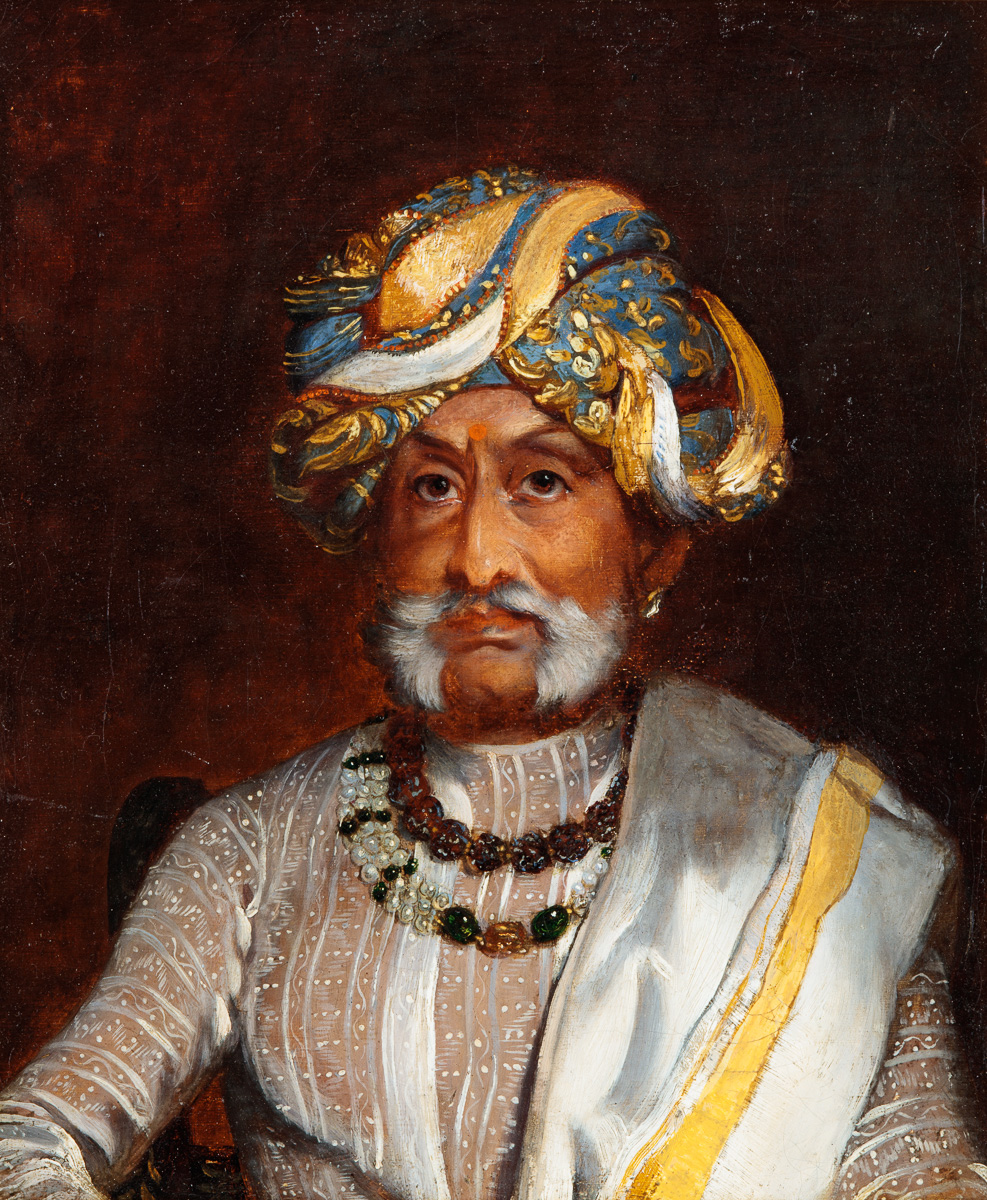
Attributed to George Landseer
Oil on canvas
Circa 1861
In his 1793 book, Travels in India, the renowned painter William Hodges advises that the next generation of artists traveling to India must possess a desire to present the truth, for “everything has a particular character, and certainly it is the finding out the real and natural character which is required.”
Maharaja Krishnaraja Wodeyar III was a man who dedicated his life to the pursuit of truth. His own personal circumstances led to a relentless desire for justice and the salvation of his family honour. The great mastery of his portrait culminates in Landseer’s evocation of the ruler’s indomitable spirit, which so adeptly reveals his true character.
After the defeat of Tipu Sultan at the Siege of Seringapatam in 1799, the five-year-old Krishnaraja Wodeyar III was appointed Maharaja of Mysore by the British. The recently annexed state was in political and economic turmoil and the Maharaja faced a taciturn Prime Minister and mounting debts. The East India Company deployed troops to assist with the Naga rebellion in 1831, and subsequently took over the administration of the state. Krishnaraja Wodeyar III was retained as the titular sovereign, and guaranteed that he would regain his position once stability had been achieved.
Over the coming decades, the Maharaja dedicated his best efforts to regaining full administration of the state and sought relief in the arts. He was a polyglot, author of several literary works and developed a new style of epic prose. His reign witnessed a flourishing of creativity in Mysore, as musicians, artists and playwrights were encouraged to visit the province. During this period, it was fashionable for Maharajas to commission European artists to paint their likeness. George Landseer was an award-winning portrait and landscape painter who had exhibited numerous works at the Royal Academy. In 1859 he left London for Calcutta at the request of Queen Victoria. Landseer was well acquainted with the artist Frederick Christian Lewis, who had established a successful career painting in India. Lewis himself had visited Mysore in I845 and 1846, to paint a portrait of the British Commissioner and complete a large painting of Krishnaraja Wodeyar III’s Durbar Celebrations. It is most likely Landseer was commissioned to paint the Maharaja’s portrait following an introduction from Lewis. Furthermore, Landseer’s endorsement from Queen Victoria made him a highly sought after artist amongst Indian patrons. During the year of 1861 he joined Lord Canning’s tour of the Himalayas as well painting portraits of the Maharaja of Indore and Gwalior. It would not be implausible thus to suggest Landseer painted Krishnaraja Wodeyar III during this fruitful period.
Hailed as one of the most capable yet underrated of Victorian painters, Landseer’s portrait of the Maharaja stands as testament to his achievements. The use of vibrant pigments to capture the beguiling jewels, the energetic brushstrokes of the turban and fleeting dashes of white to create aqueous eyes, all typify Landseer’s hand. These liberal traits delineated him from the previous generation of portraitists and imbued his works with a tangible quality of the sitter’s character.
There are four other versions of the current painting, two of which include the Maharaja’s hand clasping an ivory hilt and show him wearing a belt buckle, depicting a medallion of Queen Victoria. Whilst painted with enthusiasm and observation, the portraits fail to achieve the nuanced detail of the Landseer work, and bear a somewhat naïve quality. Queen Victoria’s diary mentions her fondness of some cattle Krishnaraja Wodeyar III had sent to her and in return she entrusted the Maharaja’s physician with reciprocal gifts. These included; “a few specimens of the manufactures of Great Britain and other articles of which Her Majesty requests your acceptance as token of Her friendship and esteem.” Lewin Bentham Bowring, Commissioner of Mysore (1862-1870) also described the Maharaja wearing a “much cherished sword with a medallion of the Queen upon the belt.” The illustrations of the medallion therefore reveal that the Maharaja sat for the portraits no earlier than 1861. This significant year marked the completion of the Maharaja’s new residence, the Jaganmohan Palace and Art Gallery. Commissioning a renowned British artist to mark the occasion would seem fitting of a ruler who was a great advocate of painting. Inviting resident court artists to the sitting also enabled them to develop their techniques in portraiture and provided new works to decorate the palace and museum.
The Maharaja’s final years were plagued by concern that the Wodeyar family may never regain their autonomy. In 1865 he adopted a son and despite sanads (certificates) guaranteeing princes their right to adopt heirs, the privilege was denied to the Maharaja. Dismayed but unrelenting, he took his case to the House of Commons. His physician led the campaign in England, forming the Mysore Caucus’ with previous Commissioners and Company officials. Rallying the press led to much public support as both nations were captivated by the seminal case. In April 1867, the Secretary of State finally informed the Maharaja that the throne would be seceded by his adopted heir. The Maharaja died the following year, having finally accomplished his lifelong goal. To this day he is hailed as a ‘freedom fighter’ who, despite interminable adversity, led an unwavering campaigned for justice.
In Landseer’s painting of the Maharaja, the priori of artist and patron to unveil the truth evokes a dialogue of reciprocity within the work. The Maharaja presents himself in true authenticity and Landseer sensitively relays this to the canvas. In turn, the viewer is invited to journey into a seminal period of British and Indian history and venerate a man who committed his life to his principals.
Bibliography
De Almeida, Hermione, Gilpin, George H. Indian Renaissance: British Romantic Art and the Prospect of India. Aldershot, England 2005.
Archer, Mildred. George Landseer (1834–78): A Forgotten Painter of the Indian Scene.’ In Rupanjali: In Memory of O. C. Gangoli. Edited by Kalyan Kumar Ganguli and S. S. Biswas. New Delhi: Sandeep Prakashan, 1986.
Archer, Mildred. Parlett, Graham. Company paintings: Indian Paintings of the British Period. London: Victoria and Albert Museum, 1992.
Archer, Mildred. India Observed, India as viewed by British Artists 1760-1860, London: Victoria and Albert Museum, 1982.
Archer, Mildred. India and British Portraiture, 1770-1825. London Russell Chambers, Covent Garden, 1979.
Bell, Evans. The Mysore Reversion, “An Exceptional Case” (2 ed.). London: Trübner and Co. 1866
Bowring, Lewin Bentham. Eastern Experiences. H.S. King, 1871.
Chakrabarti, Hiren. European Artists and India, 1700-1900. Calcutta: Victoria Memorial, 1987.
Gopal, R. Narendra Prasad, S. Krishnaraja Wodiyar III: A Historical Study.
Mysore: Directorate of Archaeology and Museums, Govt. of Karnataka, 2010.
Gray, Alexander Hill. Sixty Years Ago, Wanderings in Many Lands. London: John Murray, 1925.
Hare, Augustus J. C. The Story of Two Noble Lives; Being Memorials of Charlotte, Countess Canning, and Louisa, Marchioness of Waterford. Volume II. London: George Allen, 1893.
Hartnoll & Eyre. European and Indian Artists Working in India, 1790-1905. Hartnoll & Eyre, 1970.
Heras, H. Papers Read at the Public Meeting, Vol. II. 1868.
Ikegame, Aya. Princely India Re-imagined: A Historical Anthropology of Mysore from 1799 to the Present. Routledge, 2013.
Issar. T.P. Mysore: The Royal City. Tribhuvan Prakash 1991.
McAleer, John. Picturing India: People, Places and the World of the East India Company. British Library Publishing, 2017.
Parsons, Constance E., Mysore City. Oxford University Press, 1930.
Ramachandriah. N. S. Mysore. New Delhi: National Book Trust, India, 1972.
Rohatgi, Pauline. Indian Life and Landscape by Western Artists. Victoria and Albert Museum, 2008.
Sampath, Vikram. Splendours of Royal Mysore: The Untold Story of The Wodeyars. Rupa & Co. 2008.
Smith, Blaney Brown, and Jacobi, eds, Artist and Empire: Facing Britain’s Imperial Past. Tate Publishing, 2015.
Timothy Barringer, Geoff Quilley, and Douglas Fordham, Art and the British Empire. Manchester University Press, Manchester, 2007.
Venkatasubba Sastri, K. N. The Administration of Mysore Under Sir Mark Cubbon. London, George Allen & Unwin Ltd. 1932.
Yale Center For British Art. Company Culture: British Artists and the East India Company 1770-1830, Yale Center for British Art, 2003.
Anon. Sri Jayachamarjendra Art Gallery. Catalogue: Jaganmohan Palace, Mysore.
Journal Articles:
George Virtue, The Art journal 1849. London: Volume v.33 (1871) p. 147
Michael H. Fisher The Resident in Court Ritual, 1764-1858. Modern Asian Studies Vol. 24, No. 3 (Jul., 1990), pp. 419-458
Bengal Past and Present, Vol.50, part.1, serial No.99, Journal of the Calcutta Historical Society, 1935 p. 66
Quarterly Journal of the Mythic Society, Volume 11. Mysore, 1920